








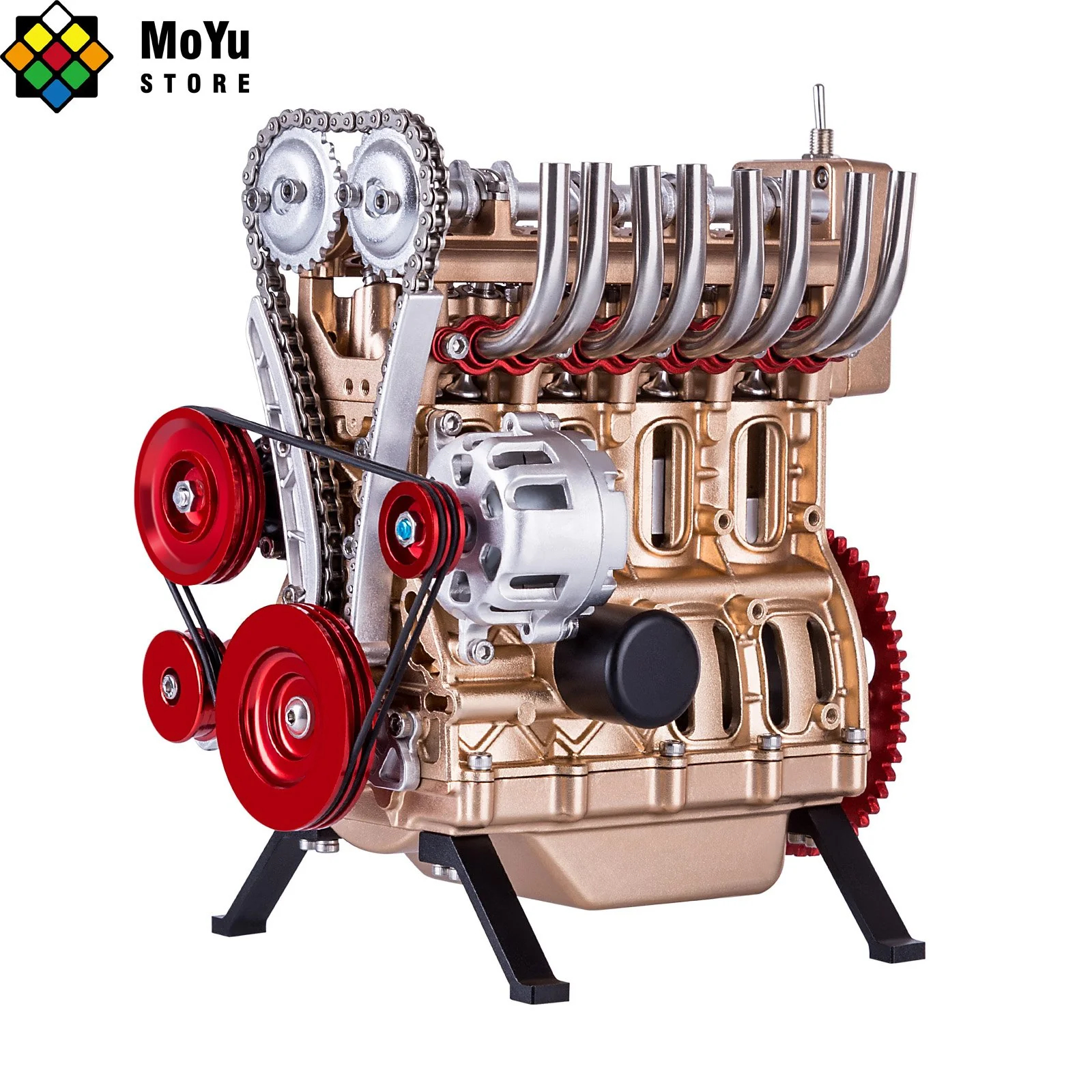


The best mechanical car model kits for adults do more than recreate the look of a classic vehicle. They give you something to build, understand, and interact with.
If you are choosing a model for yourself or for a car enthusiast, look beyond the piece count. The most important factors are the subject, mechanical functions, materials, assembly experience, and what the finished model offers beyond display.
The Teching DM229 is a good example. Inspired by an early automobile design from 1886, it combines 430+ metal components with gear transmission, screw steering, suspension, and other visible mechanical systems.
What Makes a Mechanical Car Model Worth Building?

A traditional scale model is mainly about reproducing a vehicle's appearance. A mechanical model adds another question:
How does it work?
For adult hobbyists, that can make the building experience much more rewarding.
When comparing mechanical car model kits, look for:
- Mechanical functions — gears, steering, transmission, suspension, or other moving systems
- Quality materials — metal construction can give a model a more substantial feel
- Meaningful complexity — enough components to make assembly engaging without becoming unnecessarily overwhelming
- Display value — the finished model should still be interesting after the last part is installed
- A worthwhile subject — automotive history can give the project more depth than appearance alone
In other words, don't simply ask how many pieces are in the box. Ask what those pieces actually do.
Why Historical Cars Make Great Mechanical Models

Early automobiles are particularly interesting because their importance comes from engineering as much as appearance.
On January 29, 1886, Carl Benz applied for a patent for a “vehicle powered by a gas engine.” Mercedes-Benz identifies patent DRP 37435 as the “birth certificate of the automobile.” The first public outing of the three-wheeled Benz Patent Motor Car followed later that year.
That makes early automotive designs more than vintage styling. They represent an important stage in solving the mechanical problems involved in creating a practical automobile.
There is also a longer history behind using physical models to understand engineering.
The Smithsonian's National Museum of American History notes that between 1790 and 1880, the U.S. Patent Office required inventors to submit documentation and three-dimensional working models for inventions. These models helped explain proposed innovations and compare them with other inventions.
That idea still feels relevant today: a physical model can make mechanical ideas easier to see and understand.
What to Look for Before Buying a Mechanical Car Model Kit
| What to Check | Why It Matters |
|---|---|
| Historical subject | Adds context and a story to the build |
| Mechanical functions | Makes the model more interactive |
| Material | Affects feel, structure, and appearance |
| Piece count | Indicates the potential complexity of the build |
| Assembly time | Helps set realistic expectations |
| Difficulty | Should match the builder's experience |
| Display value | Determines whether it remains interesting after assembly |
A high piece count alone does not guarantee a better model.
A 400-piece model with functioning gears, steering, and suspension can provide a more meaningful building experience than a much larger kit made mostly of decorative components.
Teching DM229: A 430+ Piece Mechanical Car Model
The Teching DM229 World First Car Scale Model Car DIY Kit takes an early automobile design from 1886 and turns it into a hands-on metal building project.
Instead of focusing only on the exterior, the DM229 incorporates gear transmission, screw steering, suspension, and visible gear, chain, and screw systems. Multiple linked mechanisms can also be manually operated after assembly.
The model uses aluminum alloy and zinc alloy components, with CNC casting and anodized finishing. It contains 430+ parts and has a listed assembly time of approximately three hours with a 3/5 difficulty rating.
DM229 at a glance
| Specification | Details |
|---|---|
| Model | DM229 |
| Material | Aluminum Alloy + Zinc Alloy |
| Parts | 430+ pcs |
| Difficulty | ★★★ |
| Assembly Time | Approx. 3 hours |
| Product Weight | 1,700 g |
| Dimensions | 11 × 7 × 7 cm |
| Recommended Age | 16+ |
The current Moyustore listing is $299.99 USD.
Explore the Teching DM229 World First Car Scale Model Car DIY Kit →
Who Is the DM229 For?

The DM229 makes the most sense for someone who enjoys the process of building, not just the finished object.
It can be a good fit for:
- Car enthusiasts interested in early automotive history
- Mechanical hobbyists who enjoy gears and moving systems
- DIY builders looking for a substantial hands-on project
- Engineering enthusiasts who like seeing how mechanisms connect
- Collectors who want a display piece with a story behind it
Its approximately three-hour assembly time also makes it a defined project rather than an open-ended build.
Mechanical Model vs. Traditional Display Model
If you are deciding between the two, think about what the builder enjoys most.
| Traditional Car Model | Mechanical Car Model |
|---|---|
| Focuses on appearance | Focuses on appearance + mechanics |
| Primarily a display piece | Display piece + interactive project |
| Exterior details are central | Internal mechanisms can be central |
| Assembly creates the replica | Assembly is part of the experience |
For someone who enjoys how things work, a mechanical model can offer something a traditional display model cannot.
The Bottom Line
Choosing a mechanical car model kit is less about finding the model with the most parts and more about finding one with the right combination of subject, mechanics, materials, and building experience.
The Teching DM229 brings those elements together through a historically inspired 1886 automobile design, 430+ metal components, visible mechanical systems, and approximately three hours of assembly.
The historical connection adds another layer. Mercedes-Benz identifies Carl Benz's 1886 patent as a landmark in automobile history, while the Smithsonian's collection of historical patent models shows how physical models have long been used to communicate mechanical ideas.
For an adult who would rather build a machine than simply display one, that difference is worth considering.
Ready to build a mechanical car of your own? Explore the DM229 →
Frequently Asked Questions

1.What should I look for in a mechanical car model kit?
Look at the mechanical functions, materials, piece count, difficulty, assembly time, and display value. Most importantly, consider whether the components actually contribute to the mechanical experience.
2.Are mechanical car model kits suitable for adults?
Yes. They can be especially appealing to adults interested in cars, engineering, DIY building, and mechanical design.
3.How many pieces does the Teching DM229 have?
The DM229 contains 430+ aluminum alloy and zinc alloy components.
4.How long does the DM229 take to assemble?
The listed assembly time is approximately three hours, with a difficulty rating of 3/5. Actual assembly time will vary depending on the builder's experience.
5.What mechanical functions does the DM229 have?
The model features gear transmission, screw steering, suspension, and visible gear, chain, and screw systems, with linked mechanisms designed for manual operation.

